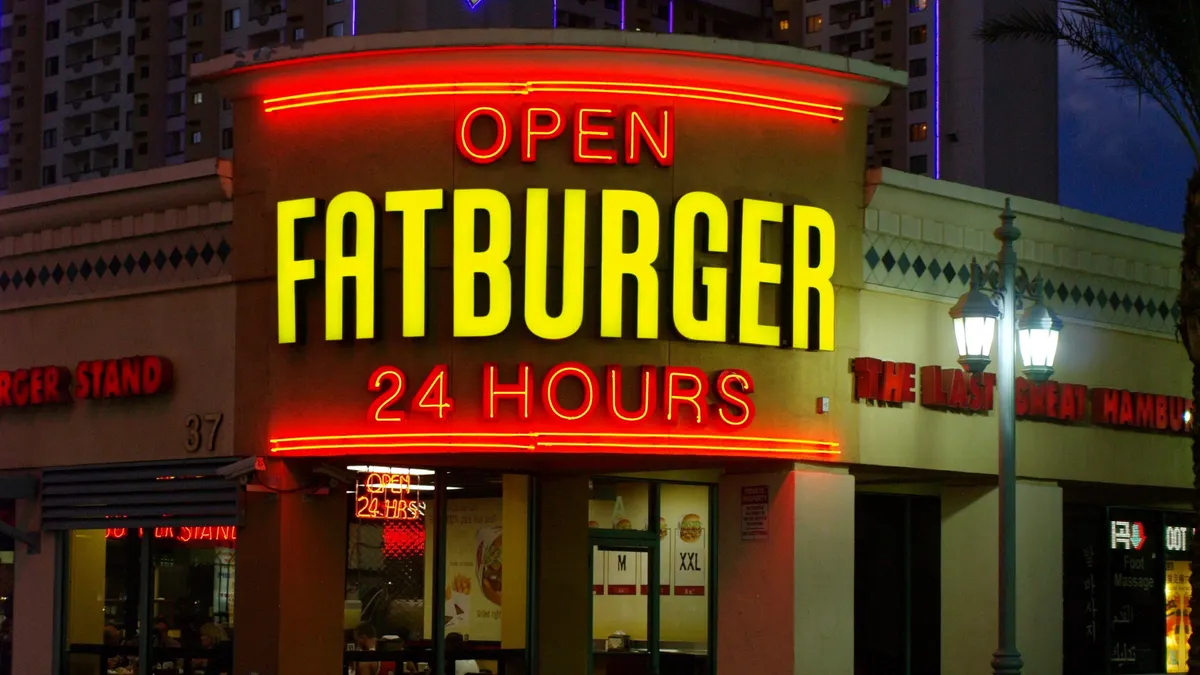
While Fat Brands spent the past few years building its portfolio of brands through acquisitions, it also created a pipeline of over 900 franchisee commitments. Over the past five years, the Fatburger parent split its growth between acquisitions and organic franchisee growth, maintaining a high percentage of franchised-owned operations.
Franchisee growth plans appeared sustainable, as these units are expected to open over the next five to seven years and generate between $50 million and $60 million in incremental earnings for the company.
Unfortunately, Fat accumulated over $1 billion in debt through its acquisitions, which destabilized the company and led it to file for Chapter 11 bankruptcy in late January.
“Bankruptcy is never a first choice for a company, but when it's required because of the business exigencies, it's like a silver bullet. It's a wonderful organizing way to retain and maximize value for the benefit of creditors and to keep businesses alive when the value of those businesses exceeds the liquidation value,” said Jerrold Bregman, a bankruptcy attorney and partner of California-based BG Law.
Bankruptcy can disrupt support and supply
While Fat Brands maintains that it’s business as usual for franchisees during the bankruptcy proceedings, experts said there are potential issues that operators should keep in mind.
“Oftentimes, as the franchisor is sliding towards bankruptcy, running out of cash, it's unable to support its franchisees and its commitments, including the supply of goods, marketing support, advertising and other related kinds of support,” Bregman said.
If a franchisor isn’t supporting its operators, it can create a level of distrust, he added. Many mom-and-pop businesses or family offices tend to be very hands-on operators and are very involved in the day-to-day operations, Bregman said.
Even before bankruptcy, Round Table franchisees sued Fat over alleged mismanagement of marketing funds. Ad support is likely going to continue to be impacted, said Gangshu “George” Cai, professor of information systems and analytics at Santa Clara University's Leavey School of Business. He added that franchisees have likely seen less support for employee training and technology or IT services.
“Because there are so many franchisees, … corporate will put some priority on some and less priority on others,” Cai said.
Supply chains could also be interrupted during the process especially if franchisees, like those at Subway, rely on the franchisor supplying all its materials. But Fat’s franchisees appear to be acting independently with the supply chain and are likely less impacted by potential disruptions, Cai said.
“If the franchisor … provides most of the materials, like the burger, or sauce, the vendors of these products might be very hesitant to … continue to provide the product and material,” Cai said. If there is a payment delay, vendors will likely be hesitant to continue offering their services.
Important communication between franchisee and franchisor must be documented with the court, and the process between franchisee and franchisor will likely become more rigid, Cai said.
Being bankrupt could also impact whether or not customers visit restaurants. Customers could think that certain restaurants are closed because of the bankruptcy or may want to come out to support the restaurants to keep them open, Cai said. Guests could also become curious about brands that are getting media attention because of the bankruptcy and want to visit, he added.
A possible sale of assets
Additionally, Chapter 11 also allows for a franchisor to sell brands, which Fat appears to be gearing up for after filing a motion last week seeking approval to begin the bidding process in April. Bankruptcy could permit franchisors to cancel franchise agreements with underperforming franchisees, as well, Cai and Bregman said.
“The worst scenario is if the franchisor considers some franchises not to be profitable anymore in the future and during this reconstruction process, they might be the first target for them to cut,” Cai said. If that happens, a franchisee has the right to object, he added.
Bregman said that it is very rare for a franchisor to cancel a franchisee agreement.
“It's unlikely they'll do it here, because franchises represent a revenue stream for the owner of the brand,” Bregman said.
Because franchisee payments are the bread and butter of the company, the top operational priority will remain supplying the franchisees and performing necessary obligations to ensure that franchisee royalty payments continue, he said.
“The franchisor will do whatever they can to encourage the franchisees to make payments,” Bregman said. “Usually it’s about soft coercion, not hard coercion.”
That also means that the franchisor needs to demonstrate that it has the ability to continue performing and remains committed to its relationships. Typically, the debtor will address its financial commitments through debtor-in-possession financing, during which the debtor brings in a large sum of money to operate and fulfill its obligations during the bankruptcy process, Bregman said. Fat is in the process of obtaining DIB financing through a deal with creditors that would temporarily sideline Andrew Wiederhorn as CEO.
“There’s actually a disincentive here to be too hard-knuckled with the franchisees. There may be and probably will be strident communication reminding [franchisees] of their obligations to perform, letting them know that it’s not appropriate to withhold payments because of the bankruptcy and trying to encourage payments,” Bregman said.
A franchisor won’t want to alienate and burden the franchisees, and franchisees can’t just terminate their contracts because of bankruptcy, Bregman added.
“[Franchisees] are compelled to remain involved with the franchisor, and everybody wants the relationships to be as positive as they can be,” Bregman said.
While Bergman has seen cases where the franchisor has threatened franchises or vendors, Bergman said he believes that in Fat’s case, the company is being run by seasoned professionals who understand the importance of maintaining good relationships with franchisees to ensure payments continue.
Ensuring strong business relationships and performance at the brand level also could come in handy if Fat has to sell off any of its brands. That could benefit franchisees since two elements have to occur for a sale to proceed.
First, the debtor has to cure any breaches in contracts with franchisees, including any money owed. Second, there needs to be “adequate assurance of future performance,” Bergman said. That means the buyer of the brand has to show that it has the financial wherewithal, usually by showing capitalization or funding, to fulfill its obligations as a franchisor, such as marketing and advertising spending and supply chain requirements.
Franchisees also have a right to claim any money owed to them during the bankruptcy process, Cai said, adding that the operators would have to show proof of a claim. That usually means the franchisee can file an unsecured claim, Bregman said.
“This is no longer business as usual,” Cai said. “The process could be slow, … it might not be desirable for the franchisees, but definitely they have the right to participate in the entire process and the right to claim money, and have the right to reject any claim by the franchisor.”