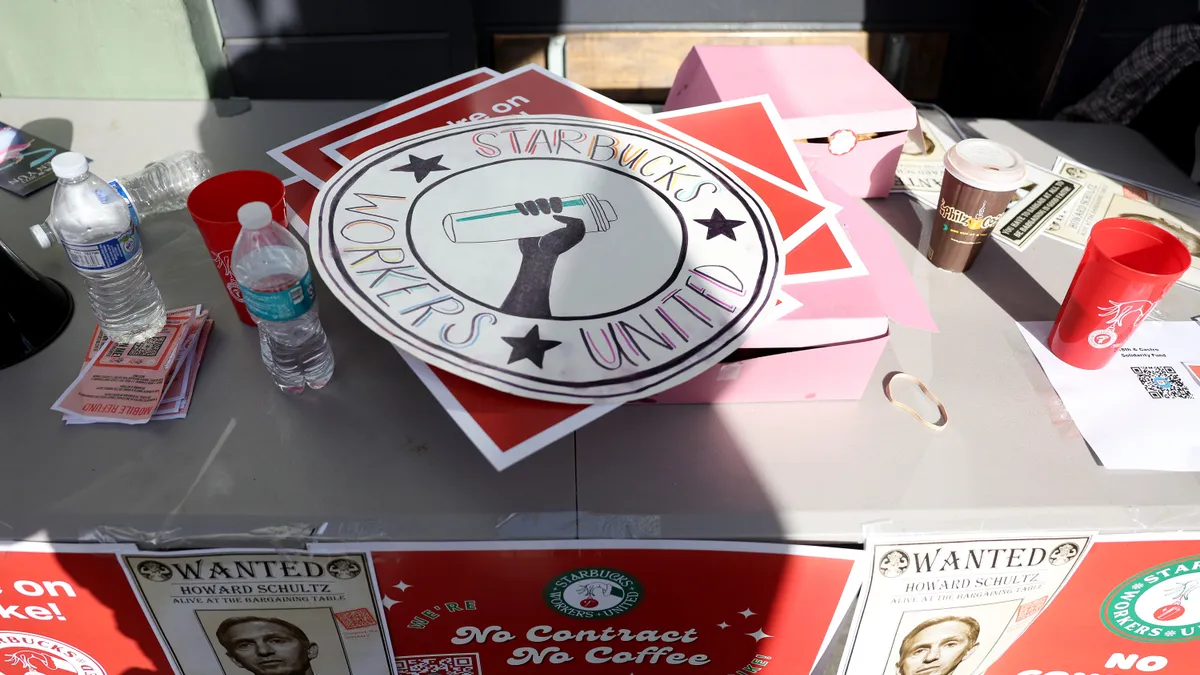
Starbucks is facing renewed pressure from investors after the company dissolved the board committee responsible for overseeing labor relations. The Environmental, Partner and Community Impact Committee was formed while the chain undertook a labor rights audit in 2023 after a shareholder vote. Pro-union investors say its dissolution shows the company may be backsliding on workers rights.
A group of activist investors, including the Strategic Organizing Center Investment Group, a fund affiliated with several major labor unions, are asking Starbucks shareholders to vote against re-electing two board members. Jørgen Vig Knudstorp, independent lead director, and Beth Ford, chair of the nominating and corporate governance committee, are under fire for dismantling the EPCI committee, said Tejal Patel, the executive director of the SOC Investment Group. Ford chaired the committee at its end, and Knudstorp is responsible for ensuring independent oversight of board activities.
“We feel as though the board isn't sufficiently overseeing labor unrest again. And it could be opening the company up to reputational, operational and legal risk."

Tejal Patel
Executive director, SOC Investment Group
At the same time, Starbucks Workers United confirmed to Restaurant Dive that it has communicated a set of revised contract proposals, including a $17 starting wage — much lower than the union’s initial $20 target — during earlier bargaining sessions.
SBWU’s weakened pay demands follow the union’s protracted strike in the fall and winter, which saw coordinated actions at scores of Starbucks cafes but failed to bring corporate back to the bargaining table.
Now a resumption of bargaining is possible, the union and the company confirmed to Restaurant Dive, despite the looming proxy battle.
Jaci Anderson, a Starbucks spokesperson, confirmed to Restaurant Dive that Starbucks proposed resuming in-person bargaining with Workers United on March 30, and said the brand was available for negotiations throughout April.
A resumption in bargaining would be a major step toward ending a years-long battle between organized workers and Starbucks leadership, which has involved protracted strikes, court battles, lawsuits, hundreds of unfair labor practice filings with the National Labor Relations Board, CEO turmoil, Senate committee hearings and massive in-person bargaining sessions.
Labor issues demand specialized attention
The coffee giant, under former CEO Laxman Narasimhan, held several major bargaining sessions with SBWU and reached a number of tentative agreements. But negotiations stalled when the union’s bargaining committee rejected Starbucks’ economic proposals in April 2025. Since then, SBWU contends, bargaining has stalled, primarily over wage proposals.
Patel said the company has backslid on labor relations since Brian Niccol took the CEO post in September 2024.
“We feel as though the board isn't sufficiently overseeing labor unrest again. And it could be opening the company up to reputational, operational and legal risk,” Patel said.
Anderson attributed the failure to reach a contract through bargaining to Workers United, and claimed the company has been engaging in good faith.
The end of the EPCI committee, which was tasked with overseeing management of labor relations and working conditions, Patel said, indicated the Starbucks board might not be taking labor relations seriously enough.
Such committees are vital to strategic decision making, as they “provide really specialized attention to complex matters,” Patel said. “Most of the real work that gets done on a board is done in committees.”
Anderson said the EPCI’s dissolution did not impact the board’s ability to manage labor relations.
“The Starbucks Board has the necessary skills and experience to effectively oversee our strategy, including human capital management, which is vital to our ability to drive growth and deliver for our customers,” Anderson said in a statement.
Other investors joined the SOC IG in its concerns, including the comptrollers of New York City and New York State and Trillium Asset Management, according to a January letter to the company. This is similar to the coalition of shareholders that ran the successful 2023 campaign urging a vote for a labor rights audit.
The SOC IG said proxy advisory firm Glass Lewis has recommended shareholders vote against Ford as chair of the Nominating and Governance Committee, citing the EPCI dissolution. Ford served as chair of the EPCI Committee at the time of its dissolution.
Starbucks said the duties of the EPCI had been taken up by the whole board and that the concerns of the SOC IG and its allies were a minority view among shareholders. Starbucks also highlighted the ties between the dissident shareholders and organized labor — the NYC and NYS comptrollers are responsible for managing union pension funds, and the SOC IG is an investment group that tries to leverage the scale of union pension funds to influence corporate policy.
Patel said that a significant vote against Ford and Knudstorp could also send a message even if both are re-elected. There are recent examples of significant, but unsuccessful, votes by activist shareholders influencing QSR operations. Notably, Sardar Biglari’s effort to prevent the re-election of Jack in the Box’s board chair failed, but the vote was close enough to suggest significant shareholder dissent, and David Goebel, the chair, announced he would give up his position as chair. Elliott Management Group also applied pressure to Starbucks over disappointing earnings in the runup to then-CEO Laxman Narasimhan’s abrupt departure in 2024.
“Our hope is that if shareholders express their discontent with how these two particular directors are addressing labor relations issues, the company is going to take a more focused look [at labor relations],” Patel said.
Is Starbucks’ relationship with workers undermining its turnaround?
Patel said changes under Niccol reflect a more difficult relationship with the union, citing alterations to the company’s dress code that triggered significant strikes in union stores last spring. The union and company had previously reached a tentative agreement on the dress code during bargaining, so Niccol’s unilateral change to the policy was a bad sign, Patel added.
A contentious relationship with employees, Patel argues, could undermine the ongoing turnaround at Starbucks.
How Starbucks sales have changed under Brian Niccol
“[The Back to Starbucks Plan] really hinges on this barista-customer connection, increasing in-store efficiency, reducing drink order complexities [and] improving partner support,” Patel said. “These are all things that actually the union baristas are asking for as well.”
Reaching a contract with the union, which represents workers in about 650 of its roughly 11,078 company-operated, North American locations, would show greater engagement with employee concerns regarding in-store operations, Patel said.
Starbucks said lowered labor turnover reflects increased employee satisfaction, following major investments in hourly labor. But that decreased turnover comes at a moment when the restaurant labor market as a whole has stabilized considerably, with real wage growth and total employment flat and turnover falling through 2024 and fluctuating month to month in 2025.
Patel said the Starbucks’ turnaround plan may have produced an uptick in traffic last quarter, but that it’s not necessarily a long-term solution.
“The company really needs to get back to constructive engagement, finalize the contract and work on executing the turnaround plan so that the performance of the company is improved over the long term,” Patel said.
Niccol’s degree of control over the company — as CEO and chair — could mean the board lacks independent leadership, Patel said, warning that his ability to act as chair and chief executive poses a risk to good corporate governance.
Could bargaining resume soon?
The weakening of SBWU’s core wage demand could indicate that the union is open to agreeing to a contract on economic terms closer to those preferred by Starbucks. However, SBWU said a $17 starting wage would still be a meaningful improvement — starting wages for Starbucks workers are between $15.25 and $16 in 43 states. The union is also asking for 4% increases in pay per year over the lifetime of the contract.
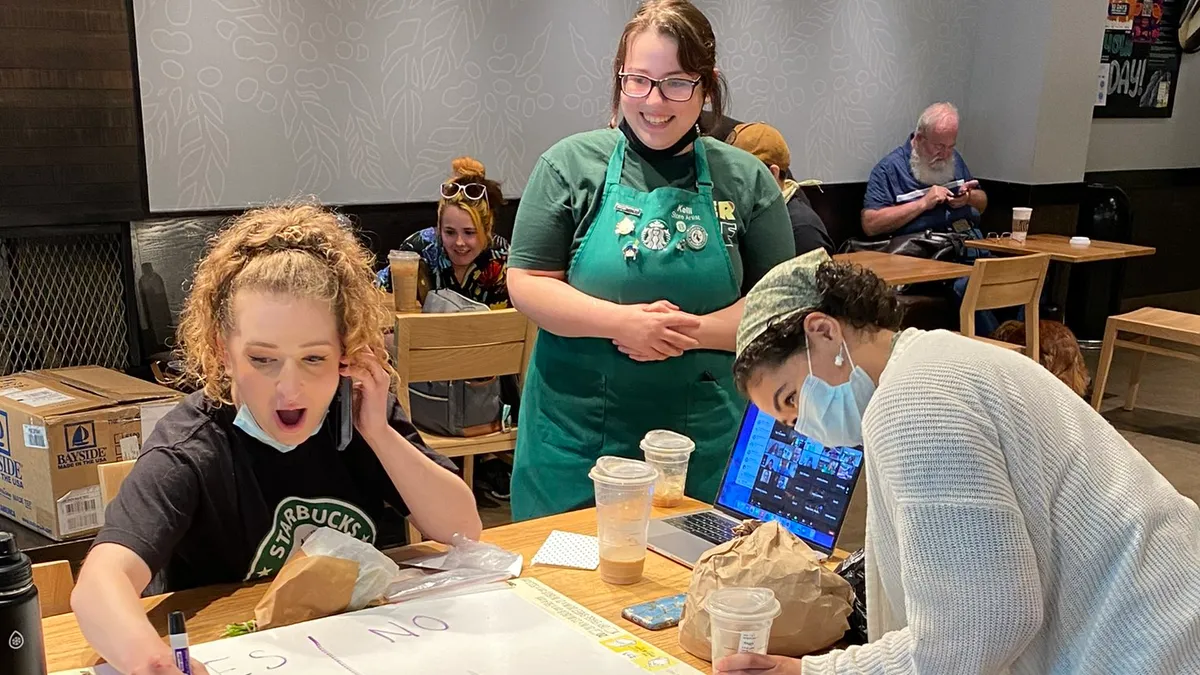
Starbucks Workers United Member Jasmine Leli said in a statement emailed to Restaurant Dive that baristas recently came to a consensus on new proposals for the company, meant to raise pay for the lowest-paid workers, implement a three-worker minimum staffing level to improve safety and customer service, and protect workers from arbitrary firings.
Leli described the new proposals as “fair and reasonable measures.”
Now, a contract is “within reach as long as executives are committed to good-faith bargaining and supporting the baristas,” Leli said.